They say one shouldn’t return to the places of childhood. Everything seems smaller—a miniature of itself, as the great Yousfi sb would say. And yet, we go back. And, more often than not, regret the decision. This is what I did this Eid visiting the colony in the small town we lived in once.
The banyan tree that once stood in front of our house is long gone. So is the lemon tree at the back. The house is in a dilapidated condition. The door was locked—maybe the occupants had gone away for Eid. The house looked exhausted, but it lit up as soon as the present mixed with memories—real or imagined.
The air-conditioned room was the centre of all activities. It served as the bedroom, the dining area, and the living space. The small kitchen is where Ammi hosted dozens of guests at a time. The small courtyard was used for birthday parties and such events.
The water tank on the roof used to be the summit of our childhood adventures. Climbing up to fix the TV antenna was a mission, with Ammi’s voice echoing from below—telling me whether the signal had improved or whether I’d just knocked the news channel off again. Sometimes I had to climb up to check if the roof had piled up with leaves and needed sweeping. The banyan’s vast canopy hung protectively above us, but it also resulted in a heap of leaves. It rarely rained, but when it did, it poured—as if making up for lost time. And we couldn’t afford clogged drainpipes.
Rain was an event. There was a floor of red bricks in front of the hospital building. In a few places, there were depressions that filled with water as soon as it rained. We’d fold our homework into paper boats and race them through the water. The entire colony would flood when it rained a little longer, turning streets into streams. I remember once, Abba was stuck at a friend’s house during a downpour. He made it back but stayed in the car, afraid a tree branch might come crashing down. The rain didn’t stop, and the next day, the kids were sent to school riding a tractor—lent by a doctor with feudal ties. It felt like a procession.
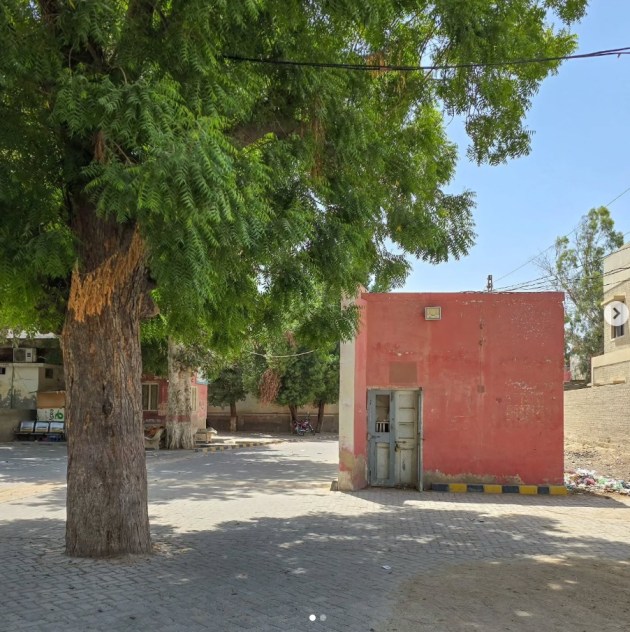
The old hospital is gone now—replaced by a newer, shinier one. I didn’t realize until much later how thoughtfully the original building had been designed. Patient wards stretched out horizontally, connected by vertical corridors with nets for ventilation, and green spaces on both sides. The ceilings were high, the walkways open. The breeze did most of the cooling—air conditioners were luxuries, not expectations. That old building had a quiet dignity, something that affected people positively. Only the old X-ray room remains from that structure, standing lonely like a relic. The neem tree above it still stands, casting the same patient shadow.
We took the road that splits the colony in half—our old cricket pitch. Every evening, it came alive with games of cricket, and badminton not far away, where children and elders played side by side. That sense of community feels so distant now.
The staff quarters on the right are still there, barely. Their walls sag, their paint peels. This is where most of our childhood friends lived. The houses were small—just two rooms—and families were large. Perhaps that’s why they were always outside, playing cricket, gulli-danda, anything that kept them engaged. A large neem tree was the reference point. Remarkably, it’s still there.
The ancient well is gone too, filled in long ago. A new structure rises where it once stood, like a secret. It used to be nearly unreachable, hidden behind wild, waist-high weeds. The only way to see it was to climb the boundary wall and walk its edge. From there, we could peer down into the dark water, overrun with reed grass. Birds had nested there. I remember the intricacy of those nests—woven like baskets—and the mystery of what lay beneath the surface.
Beyond the well, there was the lake. It was a dumping ground for partially treated sewage. But it was still good enough to sustain life, and one could find fish in it. In the winter, herons came—white and austere—nesting in the banyan and peepal trees near our home. They fished in the lake and carried their prey back to the nests. The bones fell from above, littering the ground. On cold evenings, the colony carried a strange smell. The herons, considered haram, were never hunted. Still, Abba’s assistant insisted that one of the last administrators used to eat them. We didn’t believe him, but the story stuck.
That assistant walked a long way from his nearby village to the colony. He’d been making that journey since he was young. He started as a pankah-wala, running ceiling fans with his hands—or his legs when he got tired. He would bring village delicacies: salty dates and beh, both cooked in earthen pots. Later, he worked with Abba, even after they both retired. I remember him refusing his salary when Abba had a heart stroke and couldn’t run the clinic for some time.
There was a water tank behind the lemon tree. It was surrounded by large trees and stayed humid and cool even on warm days. The colony gardener would open the valves during the evenings, and the intricate system of waterways would bring water to all the plants across the colony. We followed the water’s journey, walking around the colony.
There was a small opening in the boundary wall, possibly cut by the waiters working in Marvi Hotel on the other side so they could bring orders faster to the colony. I remember the lights went off unannounced during the ’92 Cricket World Cup final, and the entire town gathered at Marvi Hotel, which had a generator—a luxury back then. I climbed to the roof and tried to make sense of the crowd’s reaction. There was a roar when Pakistan finally wrapped the game. There was free biryani offered by the hotel the next day—though it was mainly plain rice, as we discovered later.
I used it to go and visit Afzal Bhai, who ran not only a grocery store but also kept storybooks and monthly magazines such as Naunehal, Cricketer, Taleem-o-Tarbiyat. Both the hotel and Chacha Afzal’s shop were famous city landmarks.
Both have since shut. Chacha Afzal has retired and moved back to the south of Punjab, where he hailed from, and Marvi Hotel has been converted into a school—a thriving business in the town now. The water tank, its surrounding trees, and the waterways have disappeared too. Cornicapus has filled in the space left by them.
Maybe it’s not a question of nostalgia, but a cry for old-world design, aesthetics, and values. How we design our institutions, colonies, and living spaces has an impact on how we behave and how communities shape up.


 The Karachi Walla
What a beautiful homage to nostalgia, to the days long gone, to the mystical childhood, to the times, the people, the aura of the innocent days.
This beautifully written piece takes me back to my own childhood days, to the old neighborhood, to the memories deeply entrenched my consciousness.
Those days are long gone, the times spent there are a distant memory: the places, the people, whose memories still make the neighborhood alive, they will always be alive in my memories of the days of innocence of childhood.
Thank you for sharing.
You mentioned everything that has shifted or disappeared…what about you? That little boy who climbed up the roof to discover World cup frenzy? how has he changed?